The ocean is one of the most fascinating places on Earth. It is filled with incredible creatures, mysterious depths, and powerful forces of nature just waiting to be explored. That’s exactly why I created An Ocean Exploration Unit Study!
Did you know there is an animal that lives in the ocean that never ever dies? Did you know that 80% of oceans are unexplored? Did you know that jellyfish have been around for 600 million years—before the dinosaurs?!
And that is just the tip of the iceberg. You are going to love exploring the oceans with this unit study!

What is a Family Unit Study?
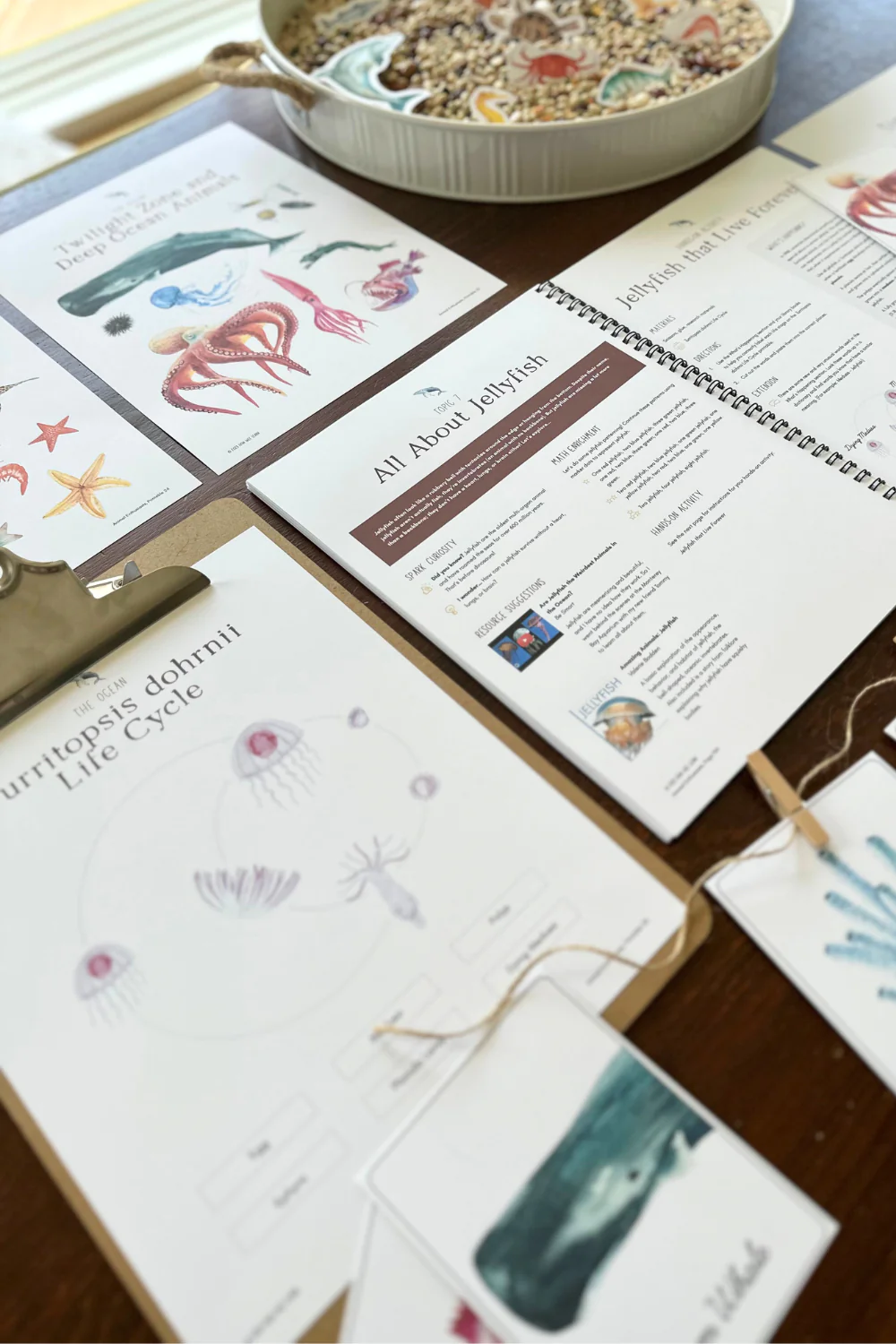
This unit study, like all of our ever-growing library of unit studies, takes one big theme—The Ocean— and breaks it down into 10 manageable, bite-sized learning opportunities. Perhaps you do one area per day, perhaps one per week. Whatever suits your fancy! You can learn and explore from start to finish in about 1-2 hours per bite-sized learning topic.
Each topic includes:
- an interesting fact,
- a discussion question,
- informative information,
- a curated YouTube video,
- a recommended book,
- a math or literacy enrichment question (with three difficulty levels),
- and an ultimate-can’t-be-beat hands-on activity!
Plus, all subjects are covered across the 10 topics! Geography, History, Science, Social Studies, Music, Art, Health, Literacy, and Math.
When everything connects across subjects, learning just makes more sense. Kids remember more, understand better, and actually enjoy the process. It’s the kind of learning that really sticks.
All ages. All subjects. One Coursebook. 🙌

An Ocean Exploration Unit Study
Before we get started, I would love to share one of my favorite activities with you! Enter your email below to receive the Wave Art Activity, along with a sample of An Ocean Exploration delivered right to your inbox.
Now, let’s get started! I am going to take a few minutes to highlight the 10 topics covered in this unit study and share some of the activities you and your little ones will explore.
Topic #1: The Oceans
Can you name the five oceans? You will be able to do just that, plus so much more once you are done this part of the unit study! Wait until you find out what the hands-on activity is in this one! So simple, yet completely brilliant (if I do say so myself!)
Topic #2: Waves
The ocean is always moving! From tiny ripples to huge crashing waves, these rolling motions are created by forces like wind, gravity, and even underwater earthquakes, carrying energy across the water as it gently rises and falls. In this hands-on activity, children create their own ocean-inspired wave art by blowing paint across paper with a straw to mimic the flowing motion of the sea.

Topic #3: The Sunlight Zone
We split this ocean unit study up into 3 zones, exploring the animals and plants that live in each one, as well as unique features of each zone. Did you know that the phytoplankton found in the sunlight zone produces as much oxygen as all of the plants found on land combined?! You will learn all about that and so much more as you explore the sunlight zone!
Topic #4: The Twilight Zone
Full of historical artifacts (more artifacts, in fact, than in all of our museums!), the Twilight Zone is what we explore next. As we discover the animals and plants that live in this ocean zone, we add to the diorama that we started in the previous topic! There are two ways to make this diorama: with shoe boxes or with water bottles. Detailed instructions, as well as printable animals you can use, are included in this Ocean Exploration Unit Study!

Topic #5: The Deep Ocean
Believe it or not, only 5% of the seafloor has been mapped out. There is still so much we just do not know! Let children wonder, question, and learn as they explore all about the incredible creatures that call the deep ocean home.
Topic #6: All About Dolphins
No Ocean Unit Study would be complete without exploring the adorable and incredibly smart dolphins! Did you know that dolphins actually give themselves names? Or that killer whales are actually a member of the dolphin family? There are so many fun and interesting facts in this section, ideal to spark wonder and curiosity in young minds and hearts. At the end of this section, you will use all your knowledge to design a fun and creative dolphin poster.
Topic #7: All About Jellyfish
You might think the most surprising thing about jellyfish is that they are not actually classified as fish. But there are so many more surprising and interesting things about these creatures! Did you know that jellyfish don’t have a heart, lungs, or brain?! If that doesn’t make you want to dive into this bite-sized learning topic, nothing will!
Topic #8: Creatures of the Deep
We have made sure that each hands-on activity uses materials you already have at home. So, with a few little alterations, we found a simple way for you to make bioluminescent paint at home! How cool is that!? If you have a few highlighters, you are set. Children will get such a kick out of this cool art + science activity.
Topic #9: Coral Reefs
Coral reefs are often called the “rainforests of the sea” because they are bursting with life. Thousands of different animals depend on these colorful underwater ecosystems for food, shelter, and survival. In this hands-on activity, you will create your own coral reef using playdough, shaping and building a miniature underwater habitat.
Topic #10: Marine Biologists
Rounding out this unit study, we explore the various roles that Marine Biologists play. The culminating activity is solving an unusual mystery, just as real Marine Biologists do! With a coral reef turning white, your budding Marine Biologist will decide what is happening AND how to fix it.

And there you have it—the ten bite-sized learning topics that make up our great big Ocean Exploration Unit Study! I hope you will pop over to check it out and consider purchasing it for you and yours.
An Ocean Exploration Family Unit Study
https://shop.howweelearn.com/products/family-unit-study-an-ocean-exploration

Thank you so much for reading!
xo
Sarah

Would this be a good unit study to teach at a co op in a class setting?
Hi Heather! Great question. Yes! These Family Unit Studies work beautifully in a homeschool co-op setting.