How does your brain help you remember things, learn new skills, and make sense of the world around you? Through simple, engaging brain activities for kids, we can begin to explore what’s really happening behind the scenes.
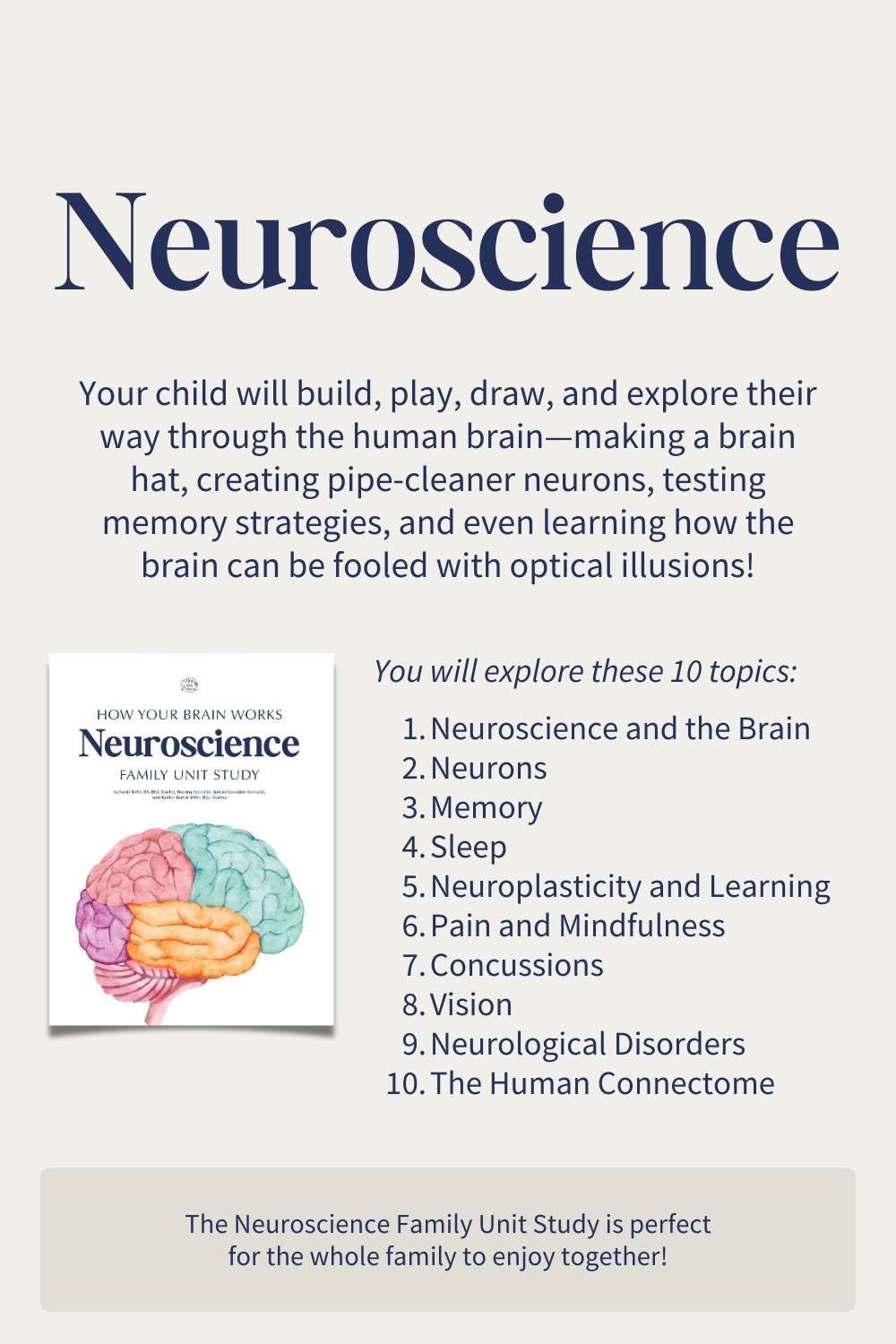
In our Neuroscience Family Unit Study, we take a closer look at how the brain and nervous system work together in everyday life. From neurons and memory to sleep, mindfulness, and more, this unit breaks big ideas down into simple, hands-on learning.
In this post, I’m going to walk you through the 10 topics included in our Neuroscience Family Unit Study and share the engaging activities your family will enjoy along the way!

What is a Family Unit Study?
But first… what exactly is a Family Unit Study?
This unit study, like all of our ever-growing library of unit studies, takes one big theme—Neuroscience—and breaks it down into ten manageable, bite-sized learning topics. This format gives you the freedom to dive into learning at a pace that works for your family. Perhaps you do one topic per day, perhaps one per week. Whatever suits your fancy! You can learn about neuroscience and explore a topic from start to finish in about 1-2 hours each.
Dive in and watch the sparks of wonder ignite. Watch the child-led learning take off. Watch what happens when children are engaged in what they are learning!
Each of the 10 topics includes:
- an interesting fact,
- a discussion question,
- informative information,
- a curated YouTube video,
- a recommended book,
- a math or literacy enrichment question (with three difficulty levels),
- and an ultimate-can’t-be-beat hands-on activity!
Plus, all subjects are covered across the 10 topics! Geography, History, Science, Social Studies, Music, Art, Health, Literacy, and Math.
When everything connects across subjects, learning just makes more sense. Kids remember more, understand better, and actually enjoy the process. It’s the kind of learning that really sticks. 🙌

Before we get our brains buzzing with all things neuroscience, I wanted to share a little something to make your homeschool days just a bit easier (because we all need that, right?).
Our Mini Homeschool Toolbox is a simple, go-to resource filled with helpful printables—like math charts, number lines, and writing supports—to keep your days organized and your lessons running smoothly.
It’s completely free and so handy to have on hand as you move through your homeschool routine. Simply enter your email address below, and a copy will be instantly delivered to your inbox.
Neuroscience Family Unit Study
Now, let’s take a closer look at what’s included in the Neuroscience Family Unit Study! Below, you’ll find the 10 topics we explore, along with some activities that bring each topic to life.
Topic #1: Neuroscience and the Brain
Your brain is always hard at work—helping you think, move, feel, and learn every single day! Let’s take a closer look at how this amazing control center keeps everything running. Then, it’s time to build your very own brain hat while learning about the different parts of the brain and what each one does. As you create, you’ll start to see how all the pieces work together!

Topic #2: Neurons
Your brain is full of tiny messengers called neurons that are constantly sending signals back and forth! Let’s explore how these amazing cells help your body think, move, and react. In this hands-on activity, you’ll create your own neuron using pipe cleaners, helping you see how each part works to send messages. Hands-on brain activities for kids like this make it so much easier to understand how everything connects. It’s a simple, creative way to bring these tiny but powerful cells to life!
Topic #3: Memory
Have you ever wondered how your brain remembers things like your favorite song or what you did yesterday? Let’s find out how your amazing memory works behind the scenes every single day. Then have some fun playing a memory-matching game!

Topic #4: Sleep
Sleep plays a big role in keeping both our brains and bodies healthy. While we rest, our brains are busy organizing what we’ve learned, while our bodies grow, heal, and recharge for a new day. For this topic’s hands-on activity, we focus on geography and music by exploring lullabies from around the world, connecting sleep with culture and music.
Topic #5: Neuroplasticity and Learning
Our brains are always growing and changing as we learn new things. Each time we practice a skill, the connections in our brain become stronger, making it easier over time. In this activity, we’ll try a mirror tracing challenge that shows just how our brains learn through practice. It might feel tricky at first, but that’s exactly how we know our brains are building new connections!

Topic #6: Pain and Mindfulness
Pain is the body’s way of letting us know something isn’t quite right. Our brains help us understand those signals and decide how to respond, both physically and emotionally. In the math enrichment activity for this topic, we’ll use simple challenges to explore grouping and numbers while connecting back to the idea of mindfulness and calm focus. It’s a fun way to build number sense while encouraging thoughtful, steady thinking!
Topic #7: Concussions
A concussion happens when the brain moves inside the skull after a bump or jolt to the head. This can make it harder for the brain to work properly, leading to symptoms like headaches, dizziness, or trouble thinking clearly. In this activity, we create a simple “brain in a cup” to see how the brain is protected and what happens during a concussion. Hands-on brain activities for kids like this help make important concepts easier to understand and remember. It’s a great way to see just how important it is to keep our brains safe!
Topic #8: Vision
Our eyes take in light from the world around us and send signals to the brain, which helps us make sense of what we see. It’s an amazing process happening every time we open our eyes! In this activity, we’ll explore optical illusions and see how our brains can sometimes be tricked by what our eyes see. It’s a fun way to discover how vision and perception work together!
Rotating Snakes Illusion
|
Scintillating Grid Illusion
|


Topic #9: Neurological Disorders
The nervous system helps our bodies think, move, and respond to the world around us. When it isn’t working as it should, it can affect how we feel, learn, and function each day. In this activity, we’ll take a closer look at different neurological disorders and create a simple infographic or organize what we learn. It’s a great way to build understanding while practicing research and presentation skills.
Topic #10: The Human Connectome
Our brains are made up of an incredible network of connections that help different parts work together. These pathways allow us to think, move, feel, and remember as everything communicates behind the scenes. For our final activity, we’ll create a piece of bilateral brain art to represent how both sides of the brain are connected and work together. It looks so cool when complete, and you’ll be strengthening that brain connection as you make it!
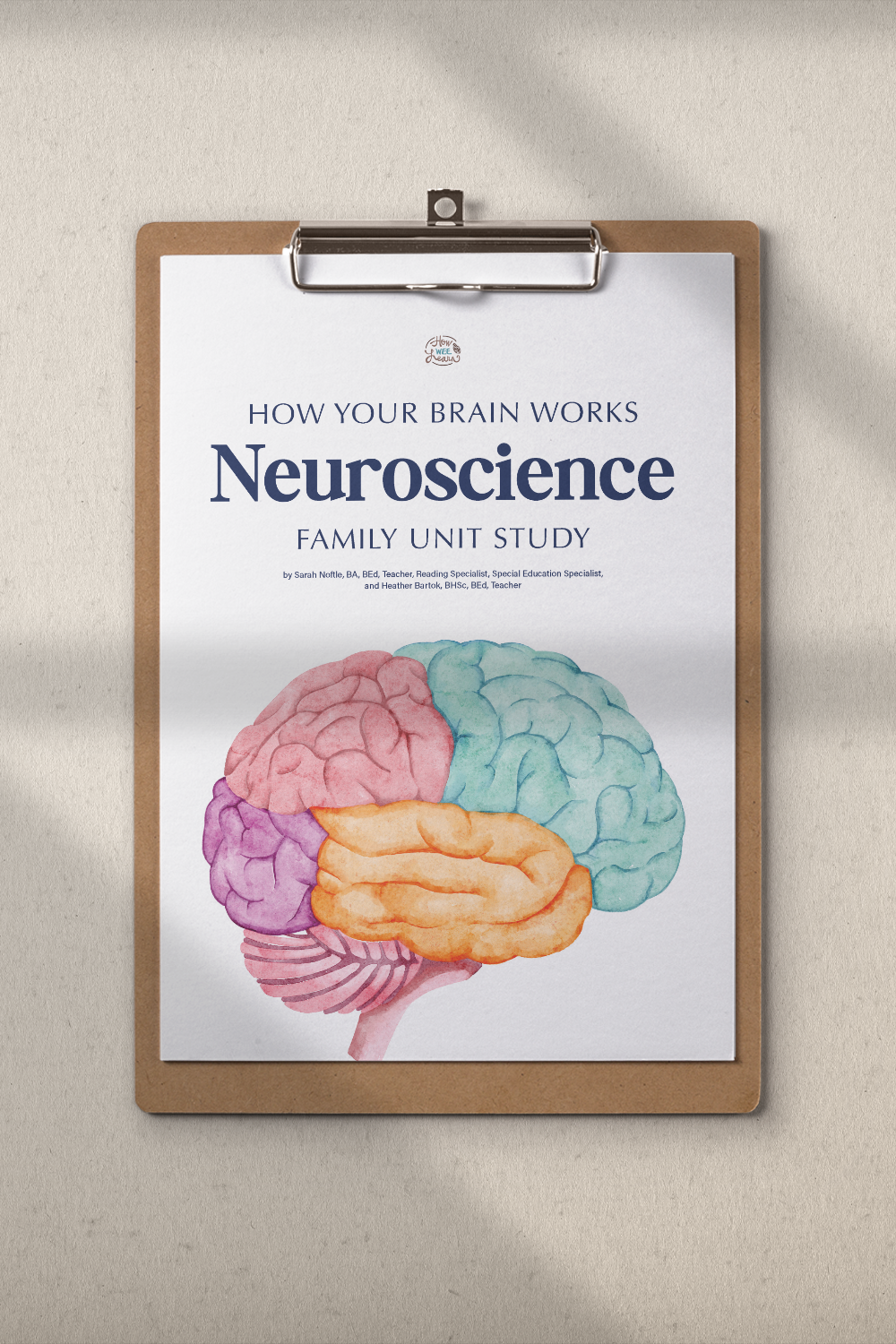
And there you have it—10 connected topics that come together to build a bigger picture of how our amazing brains work! I hope you pop over to the shop and consider purchasing it for you and yours.
Get the Neuroscience Family Unit Study in the How Wee Learn Shop!
https://shop.howweelearn.com/products/family-unit-study-neuroscience
Thank you so much for reading, friend!
xo Sarah

Leave a Reply