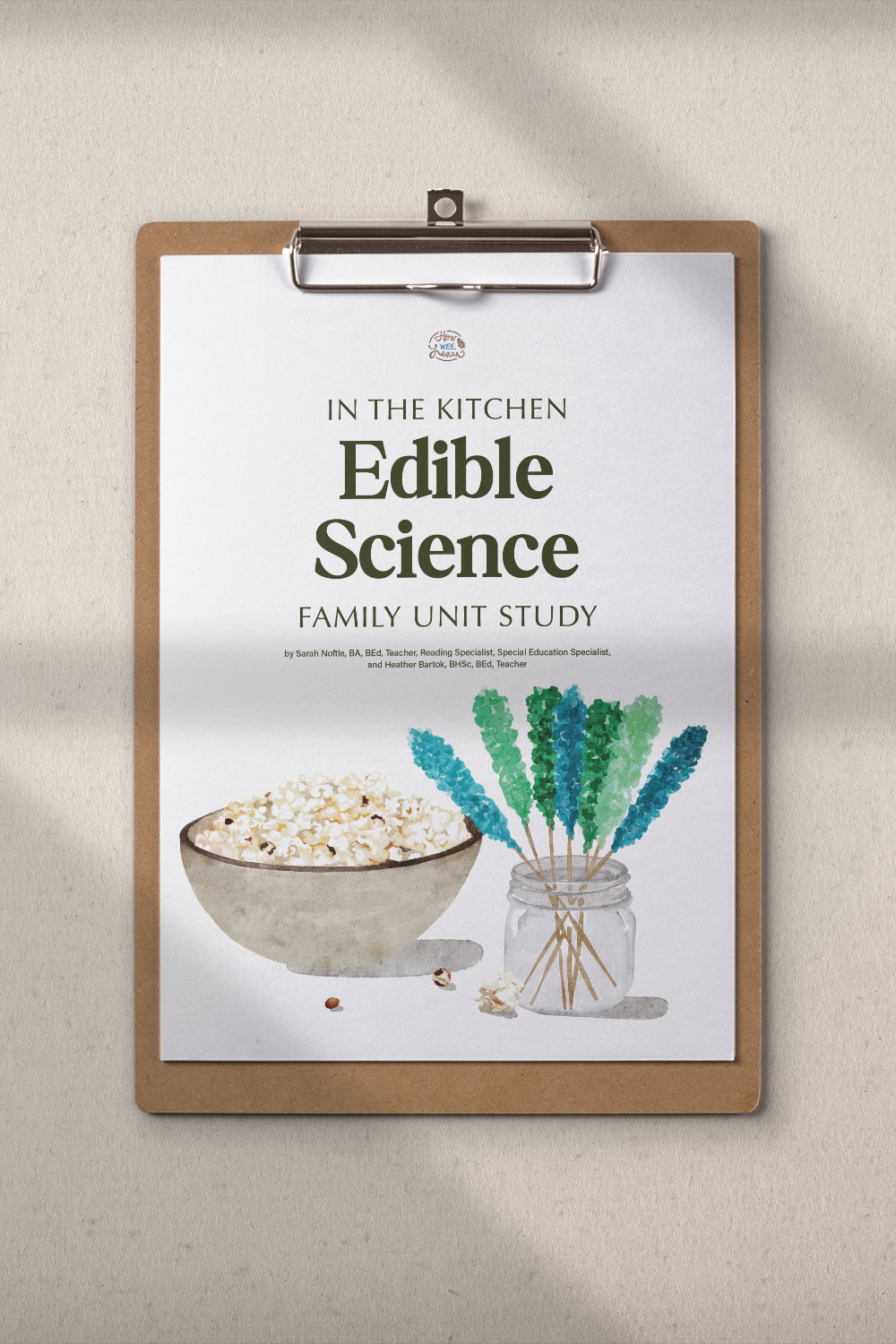
Get ready to dive into learning with food science experiments that are as tasty as they are educational! Today, I am excited to share some fantastic ways to get your kids excited about science!
Did you know that popcorn kernels are about 4% water—and that tiny bit of moisture is exactly what causes them to explode into fluffy goodness when heated? This is just one of the fascinating discoveries your kids will make as they explore the basics of physical chemistry and matter in our delicious Edible Science Family Unit Study.
If you’ve ever felt unsure about how to introduce chemistry in your homeschool, or you’re simply looking for hands-on projects that spark curiosity (and taste amazing), this unit is a perfect fit. Designed to be both educational and fun, these yummy food science experiments will keep your kids engaged and asking for seconds—of both science and snacks!

What is a Family Unit Study?
But first… what exactly is a Family Unit Study?
Like our ever-growing library of unit studies, this one takes one big theme—Edible Science—and breaks it down into ten manageable, bite-sized learning topics. This format gives you the freedom to dive into learning at a pace that works for your family.
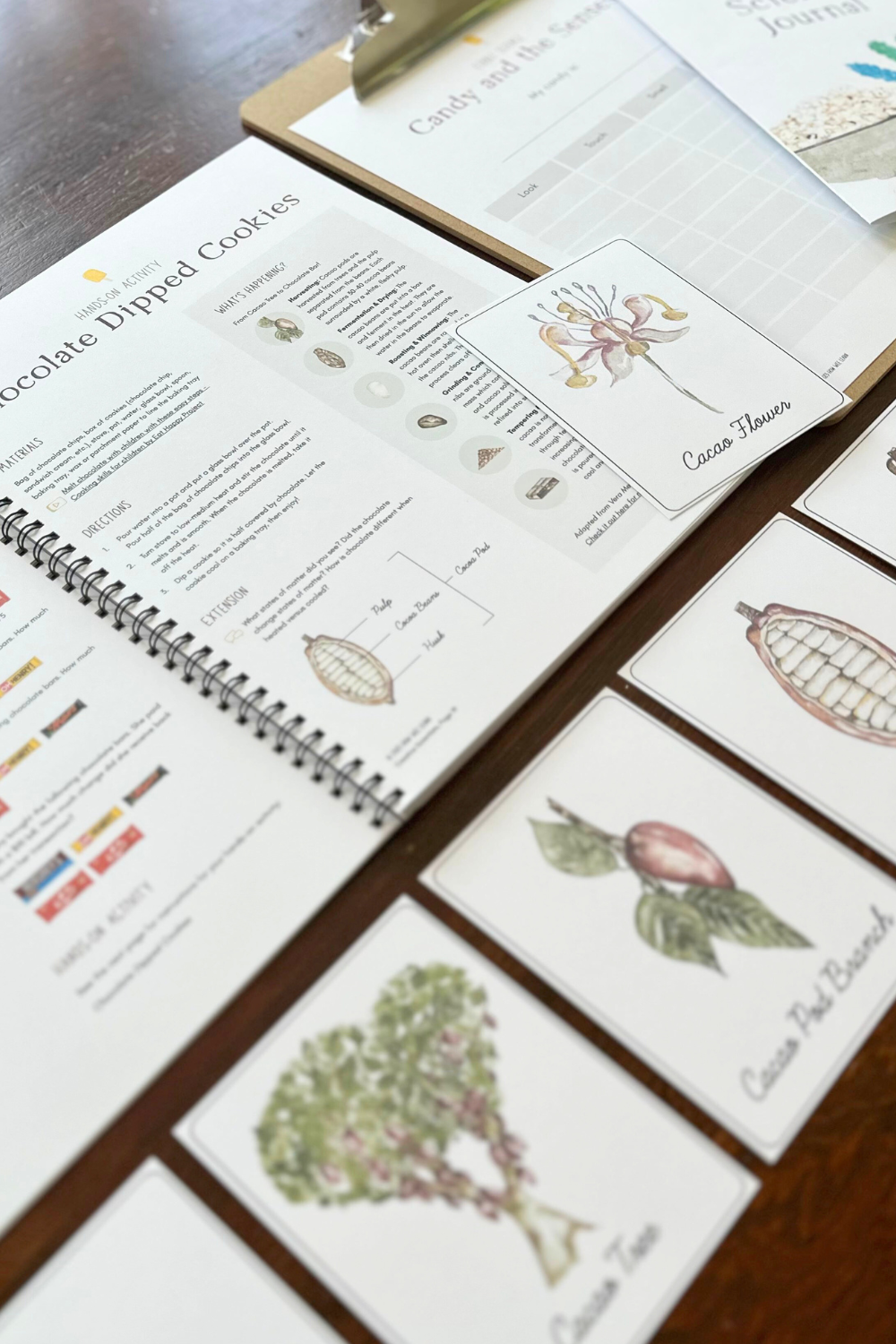
Each of the ten topics included in a unit study contains everything you need for that topic, including:
- a curated YouTube video,
- a suggested book to complement the topic,
- a “what’s happening” section,
- an interesting fact,
- a discussion question,
- literacy and math extension questions,
- and an ultimate-can’t-be-beat hands-on activity!
Plus, all subjects are covered across the 10 topics! Geography, History, Science, Art, Music, Social Studies, Health, Math, and Literacy.
When everything connects across subjects, learning just makes more sense. Kids remember more, understand better, and actually enjoy the process. It’s the kind of learning that really sticks.
All ages. All subjects. One Coursebook.

Delicious Food Science Experiments!
Let’s take a closer look at each of the ten topics that make up Edible Science, along with some exciting activities that bring the learning to life.
Topic #1 – What is Matter?
Everything around you—the food you eat, the water you drink, even the air you breathe—is made of matter. In this topic, you’ll explore the three main states of matter and how they can change from one to another. Plus, learn how to make your own slushy!
Topic #2 – Popsicles
Did you know the popsicle was invented by accident? Talk about a yummy mistake! In this activity, you’ll learn how temperature can change the state of matter as you freeze juice to make your own colorful, layered popsicles.

Topic #3 – Chocolate
Did you know chocolate comes from the cacao tree? In this topic, you will explore how chocolate is processed from bean to bar. Then, you will test out your own skills in tempering chocolate as you create chocolate-dipped cookies!
Topic #4 – Maple Syrup
Evaporation is key in transforming watery maple sap into thick maple syrup. Learn all about how maple syrup is made and the scientific terms evaporation and viscosity, then test your skills in making delicious maple taffy – such a fun (and yummy!) food science experiment!

Topic #5 – Popcorn
Why do popcorn kernels pop? Discover the science behind the iconic pop and learn how to make a perfect batch of popcorn for you and your family to enjoy!
Topic #6 – Salad Dressing
Let’s learn about density, a key property of matter! Mix oil and vinegar to create a suspension, then add an emulsifier to turn it into a smooth colloid—perfect as a tasty salad dressing. Who knew science could be so delicious?

Topic #7 – Butter
Go behind the scenes to uncover how butter is made on a commercial scale. Then, roll up your sleeves and learn about colloids by making your own fresh butter right in a jar using just cream and a little shaking!
Topic #8 – Ice Cream
Take an in-depth look at how milk becomes the ice cream we all love. Then try it for yourself with a hands-on “ice cream in a bag” experiment—and enjoy your scientific adventure’s sweet, creamy results.

Topic #9 – Tea
Explore how hot water helps tea leaves share their color, flavor, and yummy smells through a process called infusion. Then keep the fun going by hosting your very own tea party and scavenger hunt!
Topic #10 – Rock Candy
Discover the science behind crystallization and the role evaporation plays in the process. By making a supersaturated sugar solution, you’ll grow your very own rock candy—where science meets sweet!

And there you have it, my friend! The Edible Science Unit Study in a nutshell. Ha! Get it? To learn more and get a sample, visit the How Wee Learn shop today.
Grab your full Edible Science Unit Study right here:
 |
 |
Thank you so much for reading, my friend!
xo
Sarah

Leave a Reply