What would your child choose first: a seat at a medieval feast, a walk around the village market, or a peek inside a castle? The medieval world is full of questions kids love to ask. What did people eat? How did knights move in their armor? And how did travelers find their way without a phone in their pocket?
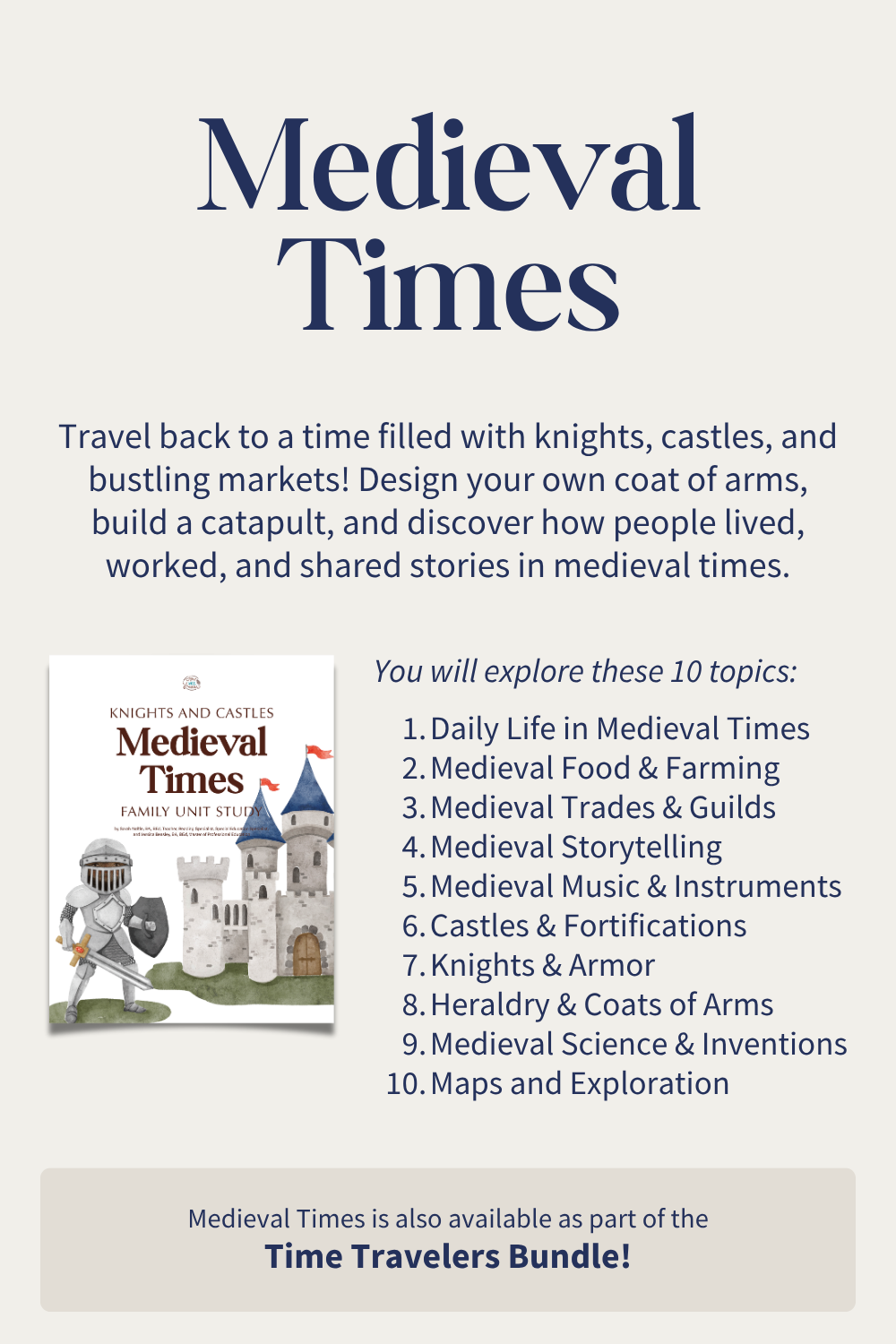
I’m excited to share our Medieval Times Family Unit Study with you! Across ten topics, your family will learn about daily life, trades, storytelling, castles, knights, inventions, and more. You’ll bake honey almond cookies, make a lute-inspired instrument, design a coat of arms, build a catapult, and follow compass clues on a hunt around your home.
Below, I’m sharing all ten topics and a peek at the activities you’ll enjoy together. Let’s step back in time!
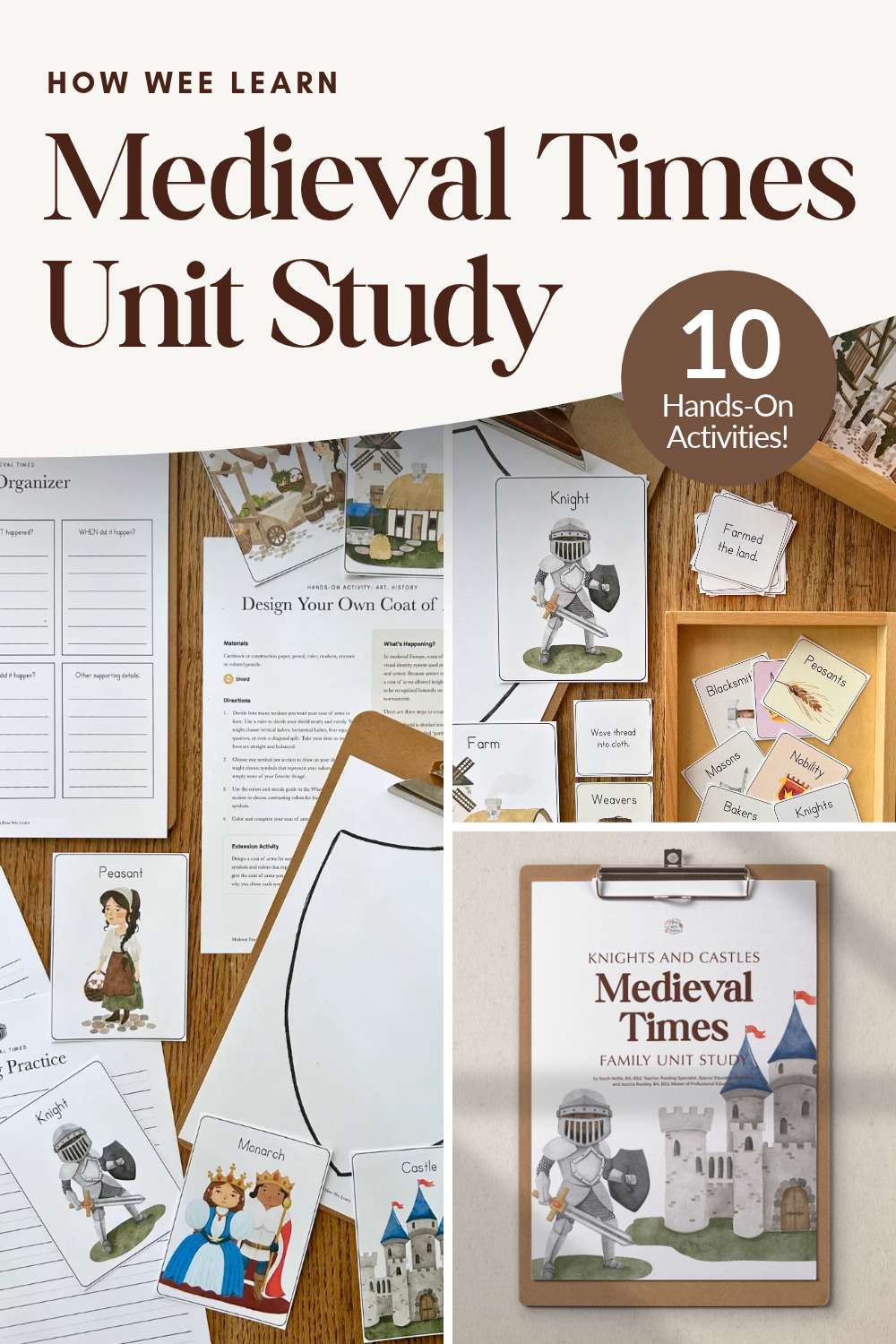
What is a Family Unit Study?
But first… what exactly is a Family Unit Study?
This unit study, like all of our ever-growing library of unit studies, takes one big theme—Medieval Times—and breaks it down into ten manageable, bite-sized learning topics. This format gives you the freedom to dive into learning at a pace that works for your family. Perhaps you do one topic per day, perhaps one per week. Whatever suits your fancy! You can learn and explore topics from start to finish in about 1-2 hours each.
Dive in and watch the sparks of wonder ignite. Watch the child-led learning take off. Watch what happens when children are engaged in what they are learning!
Each of the 10 topics includes:
- an interesting fact,
- a discussion question,
- informative information,
- a curated YouTube video,
- a recommended book,
- a math or literacy enrichment question (with three difficulty levels),
- and an ultimate-can’t-be-beat hands-on activity!
Plus, all subjects are covered across the 10 topics! Geography, History, Science, Social Studies, Music, Art, Health, Literacy, and Math.
When everything connects across subjects, learning just makes more sense. Kids remember more, understand better, and actually enjoy the process. It’s the kind of learning that really sticks. 🙌

Before we step back into the world of castles, knights, and medieval times, I’d love to share a little something to make your homeschool days just a bit easier (because we all need that, right?).
Our Mini Homeschool Toolbox is a simple, go-to resource filled with helpful printables – like math charts, number lines, and writing supports – to keep your days organized and your lessons running smoothly.
It’s completely free and so handy to have on hand as you move through your homeschool routine. Simply enter your email address below, and a copy will be instantly delivered to your inbox.
Medieval Times Unit Study
Let’s take a closer look at the 10 topics included in the Medieval Times Family Unit Study:
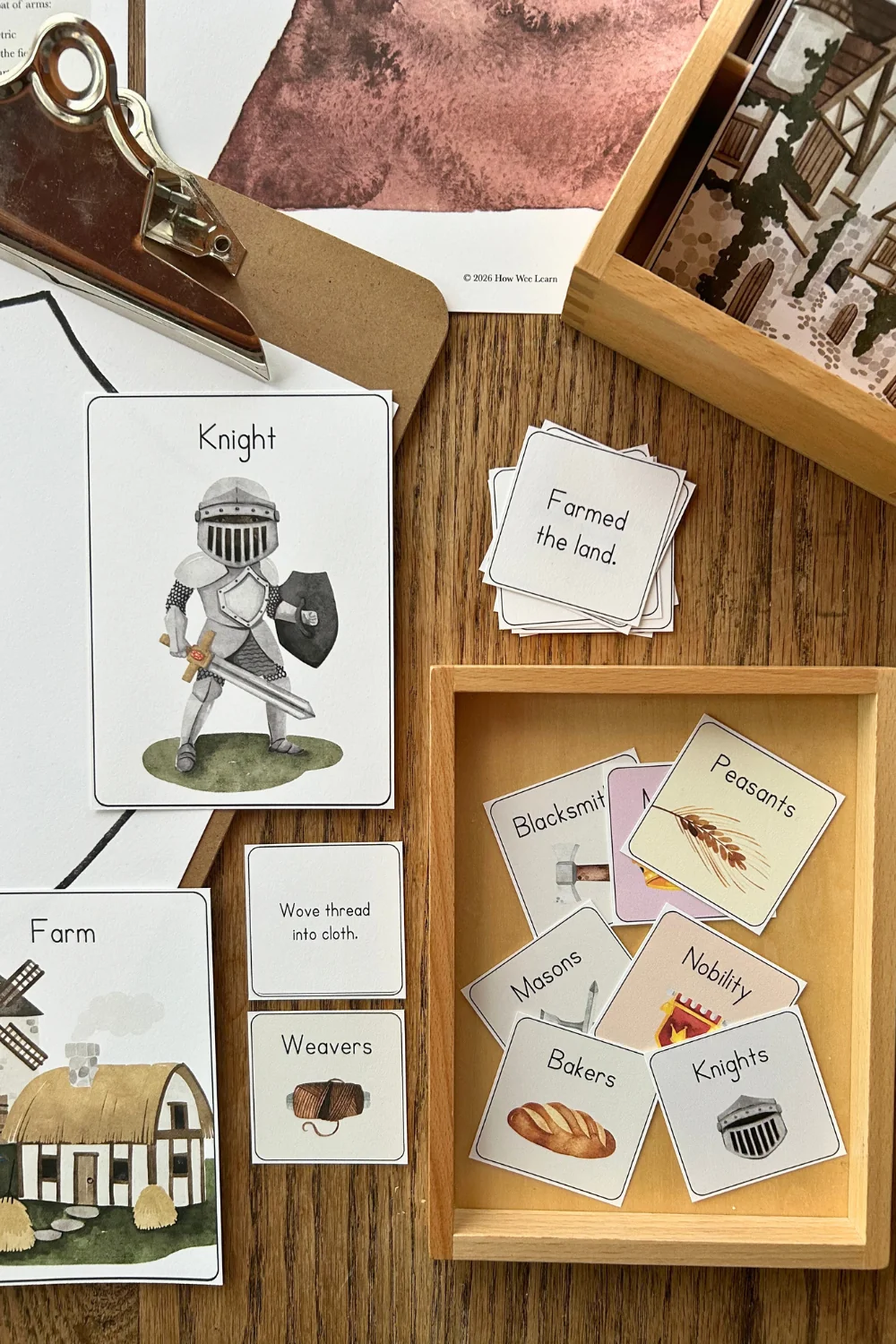
Topic #1: Daily Life in Medieval Times
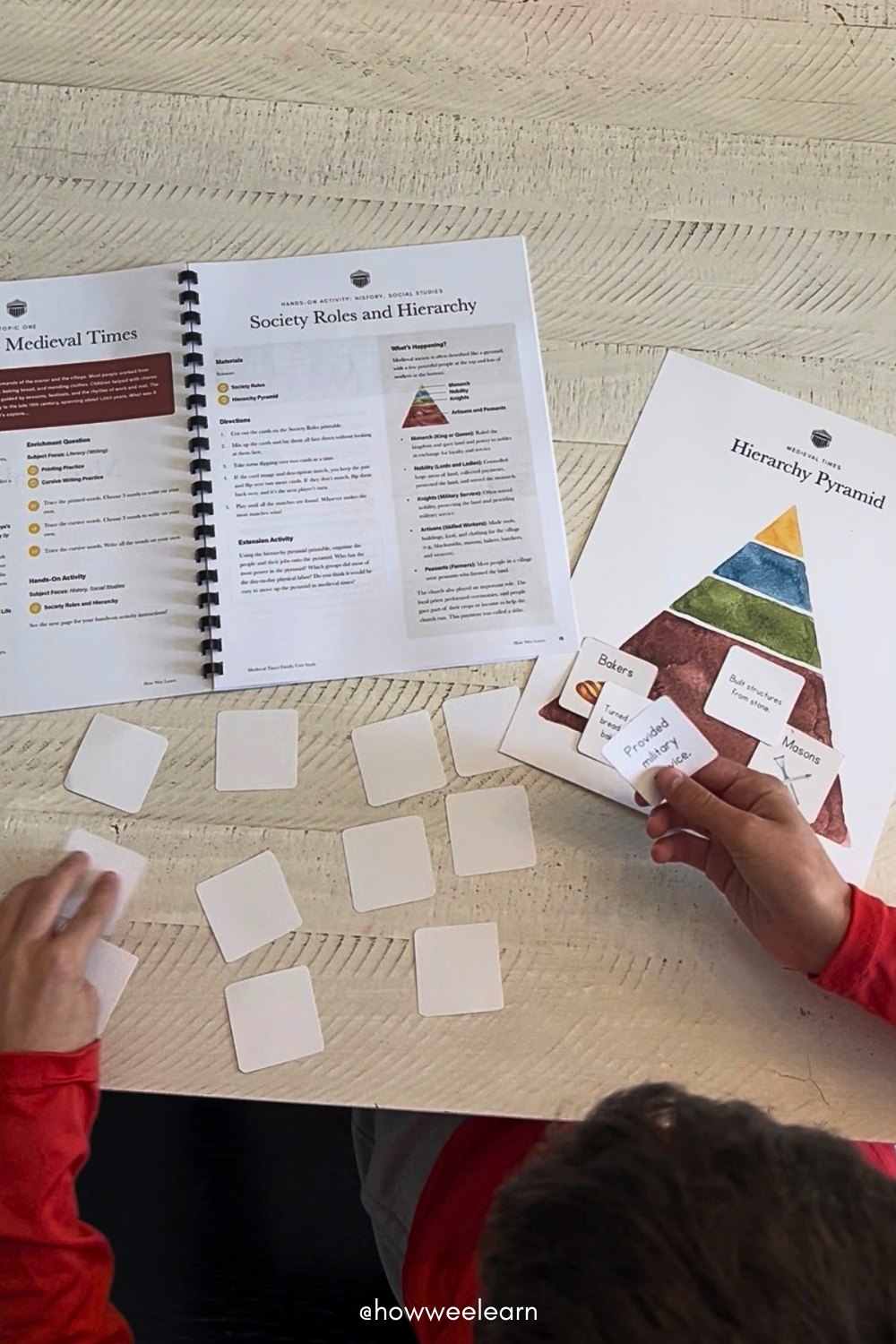
What would it have been like to grow up in a medieval village? You might have helped tend crops, cared for animals, or learned to bake bread alongside your family. You’ll meet the people who kept the village running with a matching game, then arrange them on a pyramid to see how medieval society was organized.
Topic #2: Medieval Food and Farming
Imagine helping in the fields all day and coming home hungry. What would be for dinner? In a medieval village, it might depend on what your family grew, gathered, or saved from the last harvest. And if you were lucky enough to have a sweet treat, honey might take the place of sugar! For this hands-on activity, you’ll make honey almond cookies and see how a few simple ingredients undergo physical and chemical changes as they bake.
Topic #3: Medieval Trades and Guilds
Who would you visit if you needed a loaf of bread, a horseshoe, or a new piece of cloth? Medieval towns were full of skilled workers, and many learned their trade as apprentices before joining a guild. You’ll set up your own medieval market, take turns as shopkeepers and customers, and use play coins to buy and sell your goods.
Topic #4: Medieval Storytelling
A storyteller has arrived in your village! What tale will they tell tonight? Bards and minstrels entertained medieval crowds with songs and stories about heroes, battles, and news from faraway places. Now it’s your turn: you’ll dream up a tale inspired by something happening in your own home or neighborhood, write it down, and perform it for your family like a traveling bard!
Topic #5: Medieval Music & Instruments
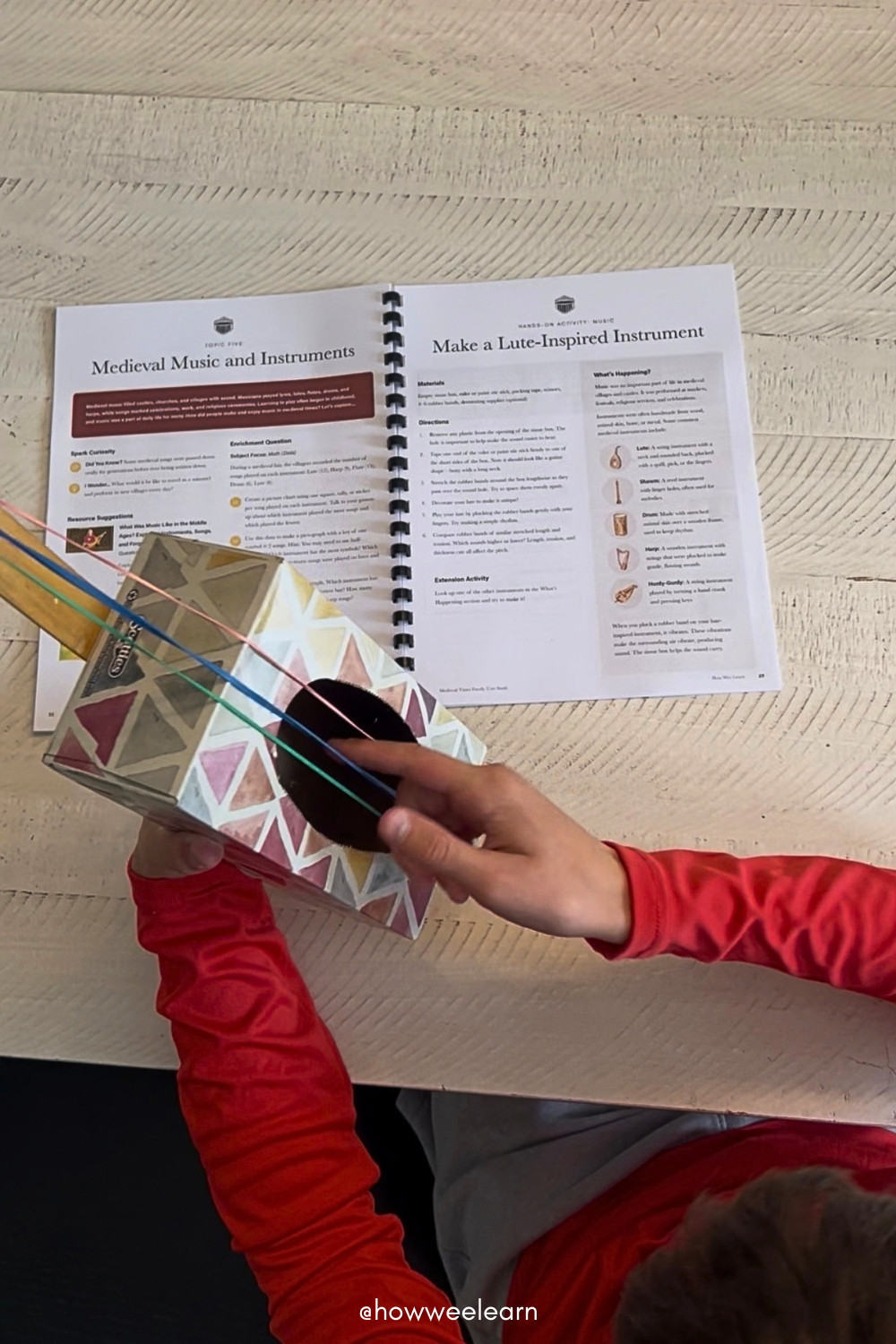
Can you hear the drums at a village festival or a lute playing in the castle hall? Music was part of medieval celebrations, markets, and everyday life, with musicians playing everything from harps to flutes. You’ll make your own lute-inspired instrument from a tissue box and rubber bands, pluck the “strings,” and see how changing them changes the sound!
Topic #6: Castles and Fortifications
A castle might have towers, thick walls, and a gate built to keep enemies out, but what was going on inside? Cooks prepared meals in the kitchen, guards watched the entrance, and people gathered in the great hall. For this topic, you’ll choose a castle room and turn a shoebox into a miniature version, complete with details that show how people used it.
Topic #7: Knights and Armor
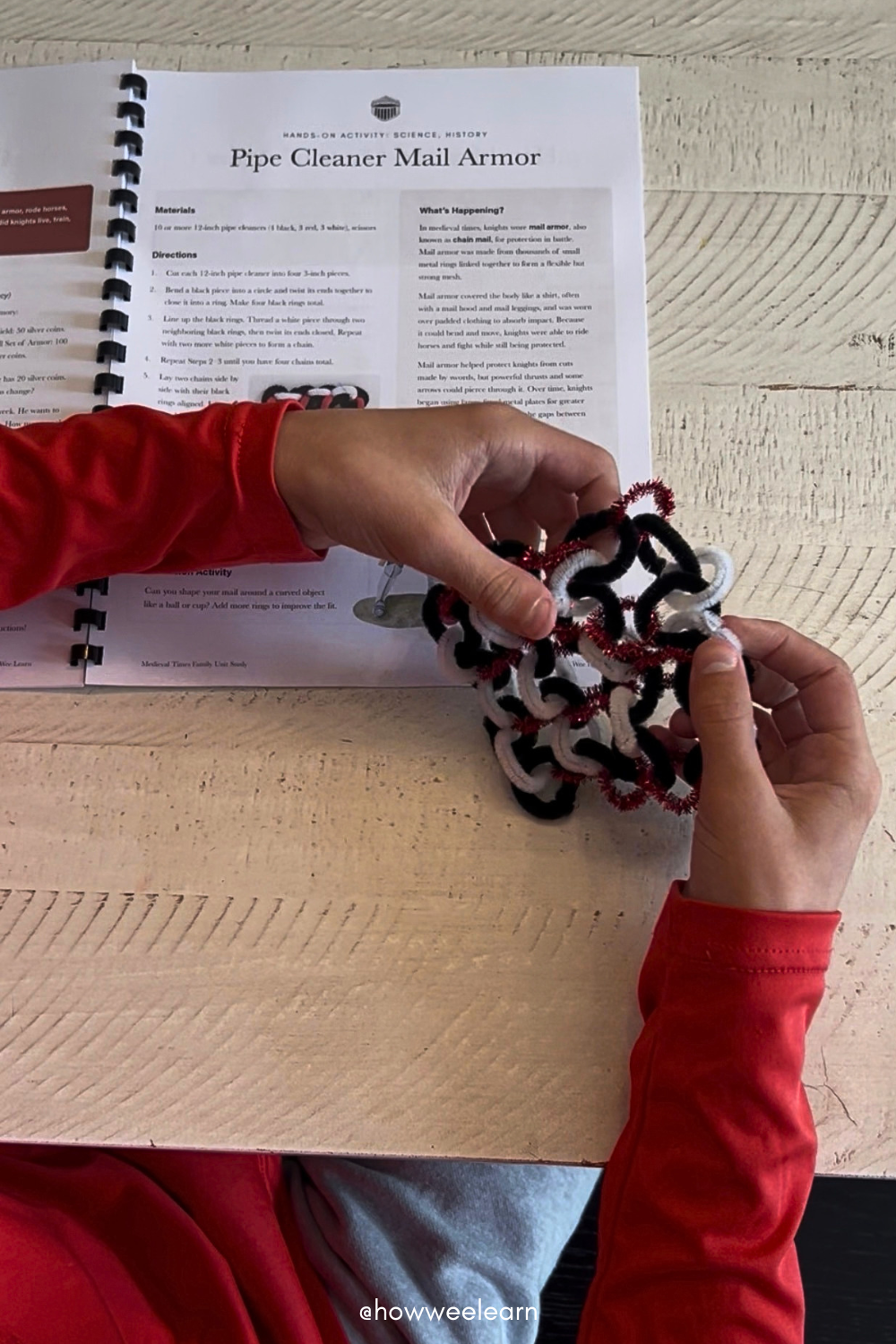
Ever wondered how a knight could move in all that armor? Knights trained for years to ride, fight, and serve, and their armor had to protect them while still letting them move. You’ll link pipe cleaner rings to make your own piece of mail armor, then bend it to see how those tiny rings worked together.
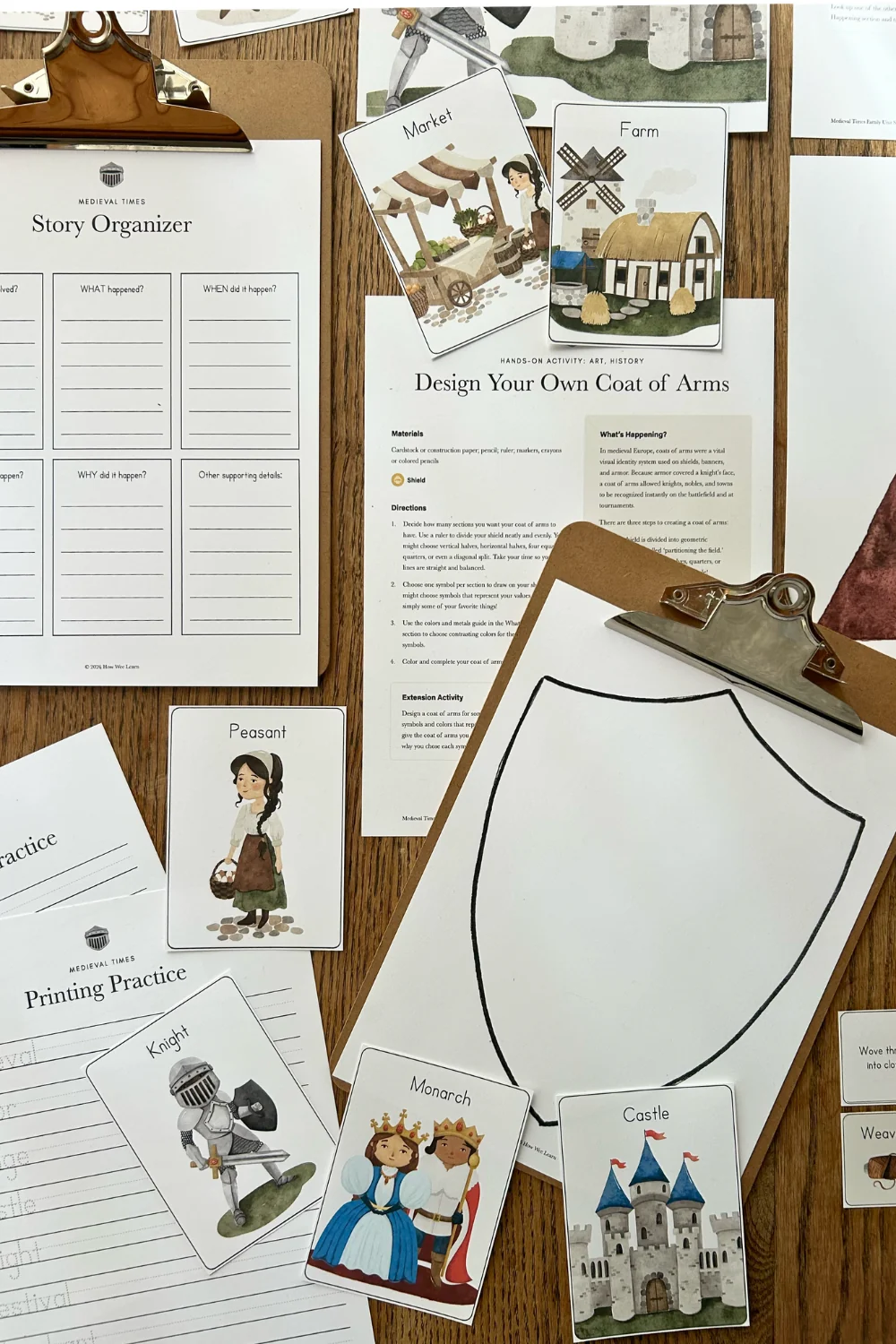
Topic #8: Heraldry and Coats of Arms
Picture a knight riding into a tournament with a brightly painted shield. How would the crowd know who it belonged to? Coats of arms used colors and symbols to identify knights, families, and towns – even from a distance. You’ll design your own coat of arms, choosing symbols that say something about you and colors that make your shield stand out.
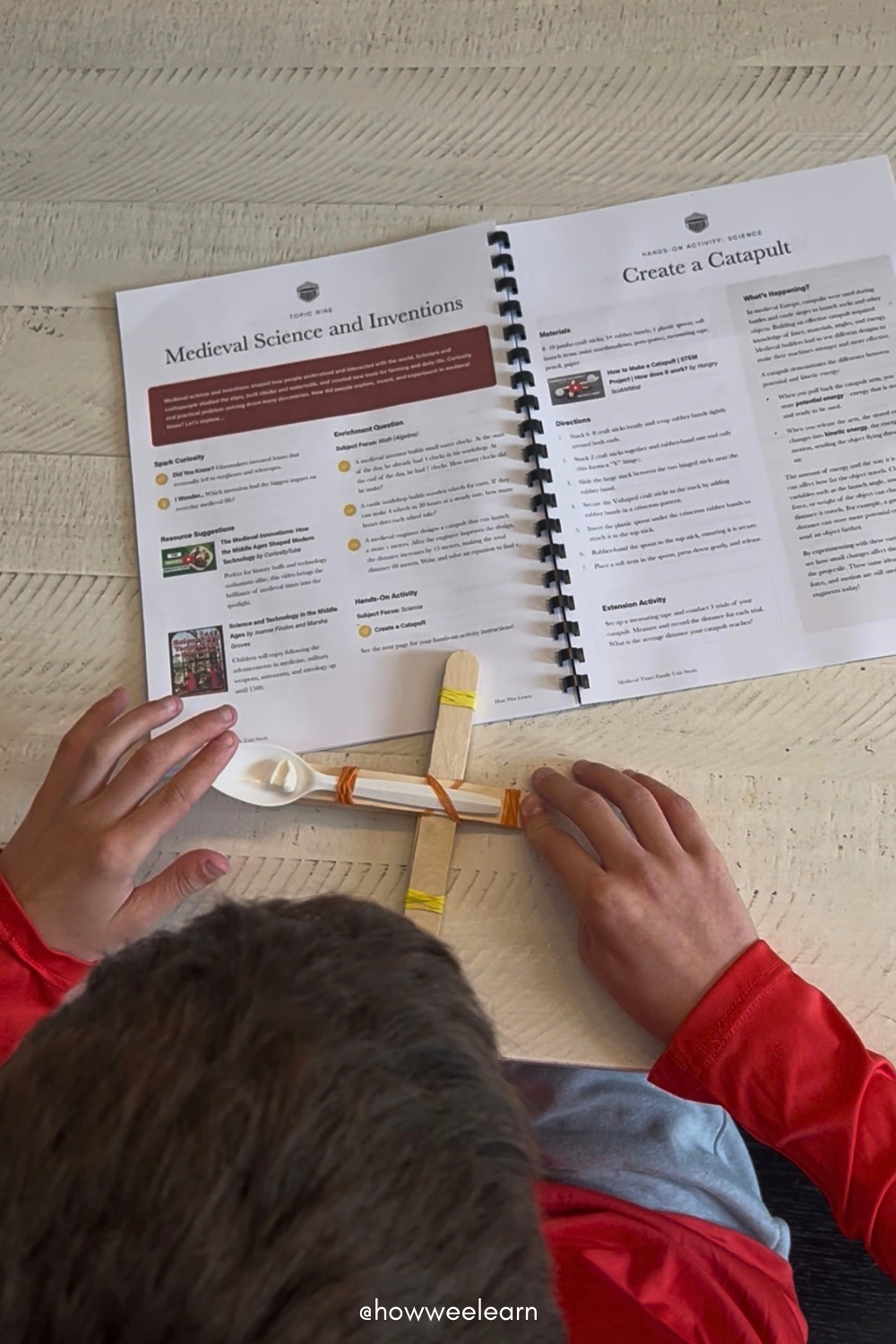
Topic #9: Medieval Science and Inventions
Ready to send a mini marshmallow flying? Medieval builders put their knowledge of materials and motion to work on machines such as catapults, while other craftspeople made tools that helped with farming and daily life. You’ll build a small catapult from craft sticks, rubber bands, and a spoon, then test how far it can launch a soft object!
Topic #10: Maps and Exploration
Your next stop is the castle – but which way is it? Medieval travelers used landmarks, directions from other people, and eventually compasses to help them find their way. You’ll put those navigation skills to work in a hunt for hidden castle, village, market, and farm cards, using a compass and clues to find each one!
 And there you have it! Ten topics that take your family from a busy medieval village to the halls of a castle and beyond. Along the way, your child will get to know the farmers, craftspeople, storytellers, and knights who all had a part to play in medieval life.
What I love about this unit study is how it helps kids picture the people behind the history. What might a day in a medieval village have looked like? Which job would you have wanted to learn? How would you have found your way to the next town? Those are the kinds of questions that can keep the conversation going long after a lesson ends.
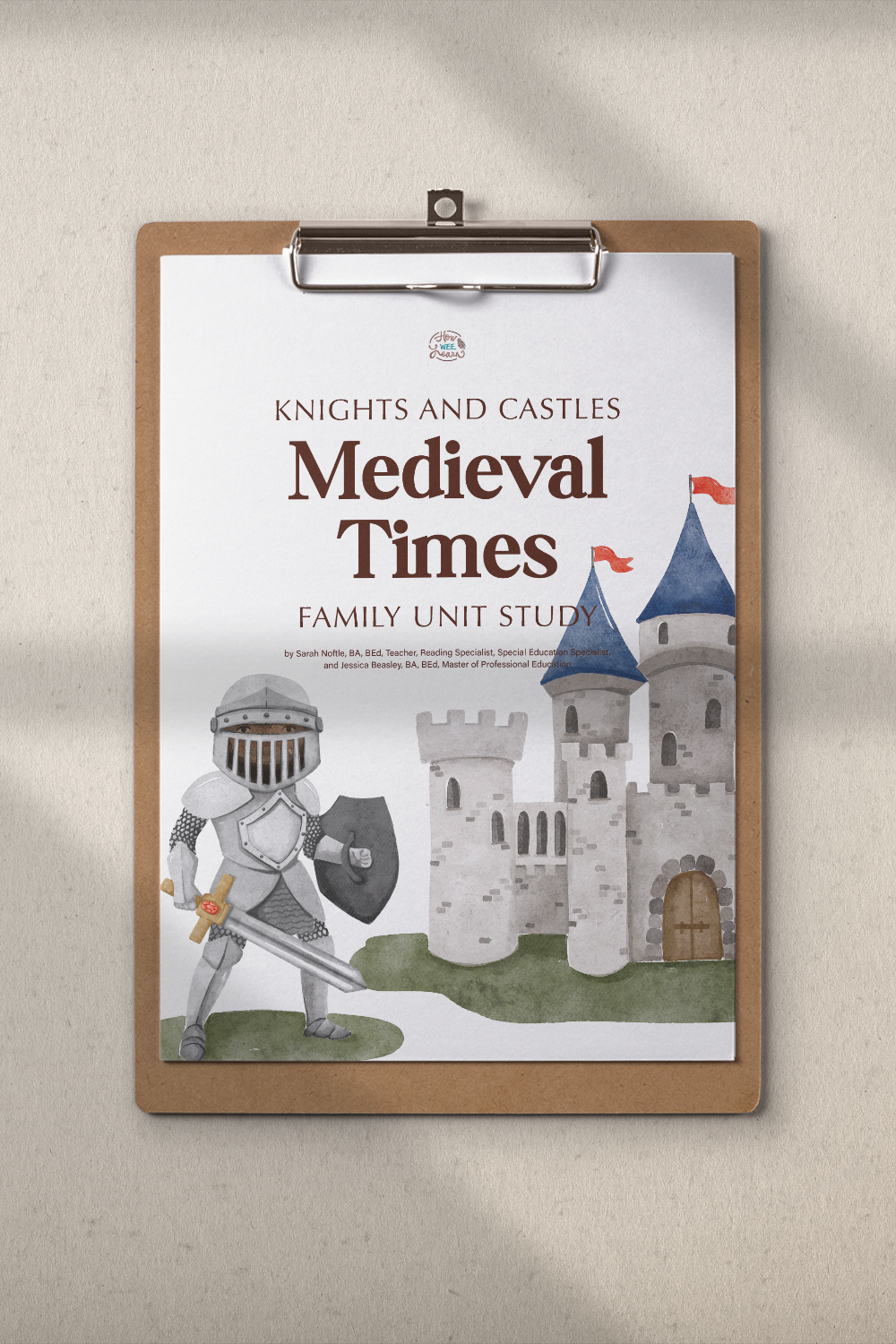
I’d love for you to pop over to the How Wee Learn Shop, take a closer look at the Medieval Times Family Unit Study, and see if it’s a good fit for you and yours!
Medieval Times Family Unit Study
https://shop.howweelearn.com/products/family-unit-study-medieval-times
 |
 |
Thanks so much for reading, friend!
xo
Sarah

Leave a Reply